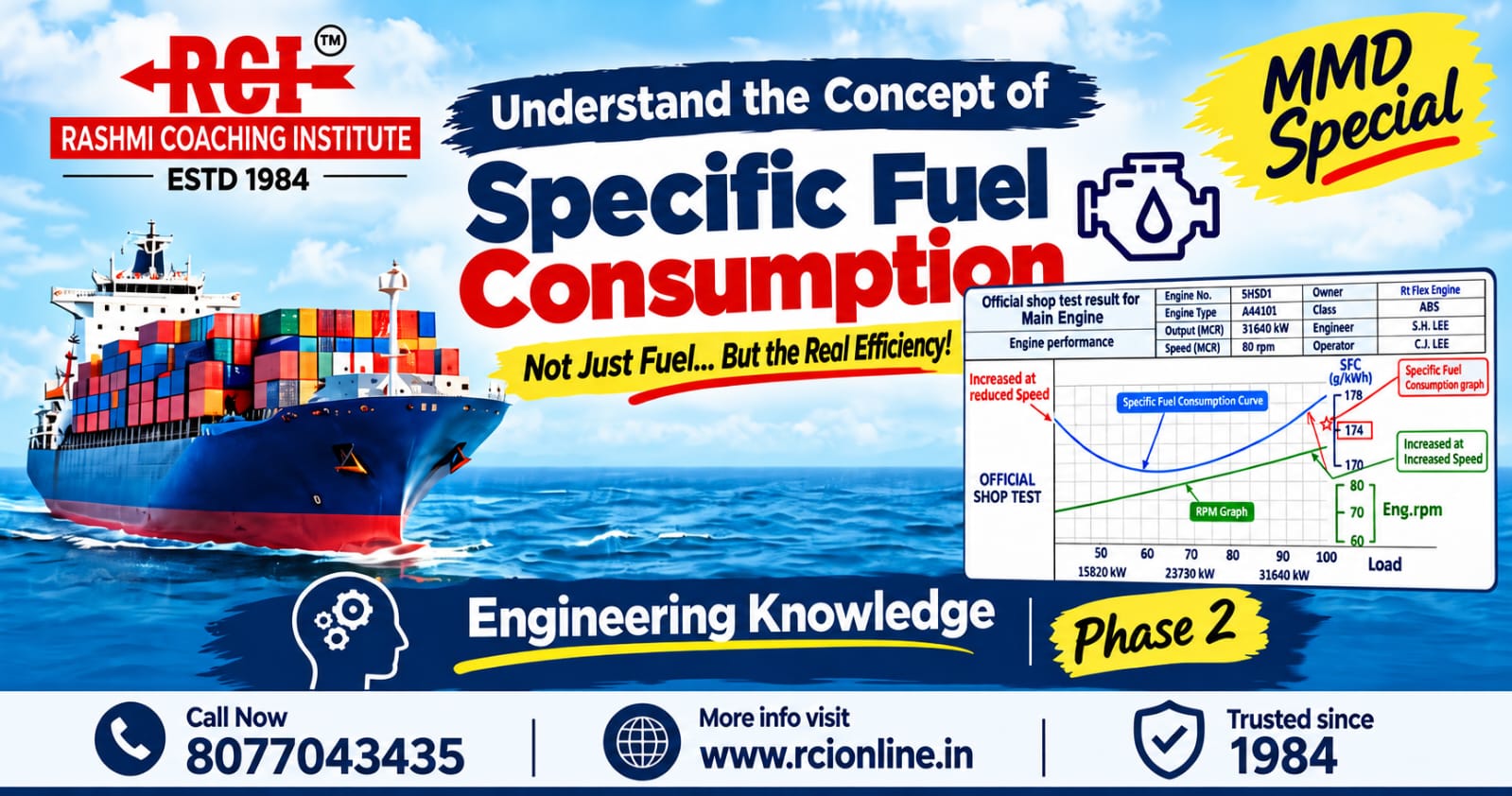
In a marine engine, when engine speed increases, more power is generally required, and therefore fuel consumption increases.
Similarly, when we reduce the vessel speed, less engine power is required, resulting in lower fuel consumption.
But there is an important point that every Marine Engineer or officer should understand:

Suppose one vessel consumes 65 MT/day, while another larger vessel consumes 122 MT/day.
Converting to hourly consumption:
65 MT/day ÷ 24 = 2.72 MT/hr
122 MT/day ÷ 24 = 5.08 MT/hr
The two vessels may have completely different engine powers because ship size, displacement, cargo carried and required speed are different.
In our example, smaller engine developing around 16,000 kW will naturally consume much less fuel than a larger engine developing around 36,000 kW, even though both engines may have similar efficiency.
The important parameter is therefore:
Specific Fuel Consumption (SFC)
If we divide the fuel consumption per hour by the engine power:
The unit is:
For a modern, efficient marine engine operating close to its design condition, SFC may typically be around 0.16–0.18 kg/kW·hr.
Therefore, two engines can have the same SFC but completely different total fuel consumption, simply because their power outputs are different.

When the engine operates away from its design condition, the specific fuel consumption may increase due to changes in operating conditions, injection timing, combustion efficiency and other factors.
Therefore, in a numerical problem, if the question states:
“Specific fuel consumption at the lower speed is 10% higher”
we must increase the SFC (kg/kW·hr) by 10%, not simply increase the fuel consumption by 10% when reducing speed.
This distinction is very important when solving MMD examination numerical.
The normal fuel consumption of a vessel at 15 knots is 45 tons/day. It is decided to reduce the vessel speed to reduce fuel consumption to 20 tons/day. Find the speed at which the vessel should be operated. Assume that the fuel consumption per unit power per hour at the lower speed is 10% higher than that at 15 knots.
Try to solve it yourself first.

The purpose of sharing these examples is not to canvass or ask anyone to join any class. It is simply to encourage students to understand the correct engineering concept and correct MMD numerical procedure.
There are many simplified explanations available on the internet. However, in engineering examinations, understanding the correct procedure is more important than memorising a shortcut.
If you are preparing for your MMD examination, always ask yourself:
“Do I understand why I am using this formula?”
That understanding makes numerical problems much easier and helps avoid losing marks due to an incorrect answer.

RCI Marine — Trusted Since 1984 📞 8077043435 | 🌐 rcionline.in
Deepak Gupta, Chief Officer — Founder & Lead Instructor, RCI Marine Trusted since 1984
© 2026 Rashmi Coaching Institute (RCI). All Rights Reserved. This article is original content created by Rashmi Coaching Institute (RCI). No part of this publication may be reproduced, copied, distributed, translated, or republished in any form without pr

No comments yet — be the first to share your thoughts.