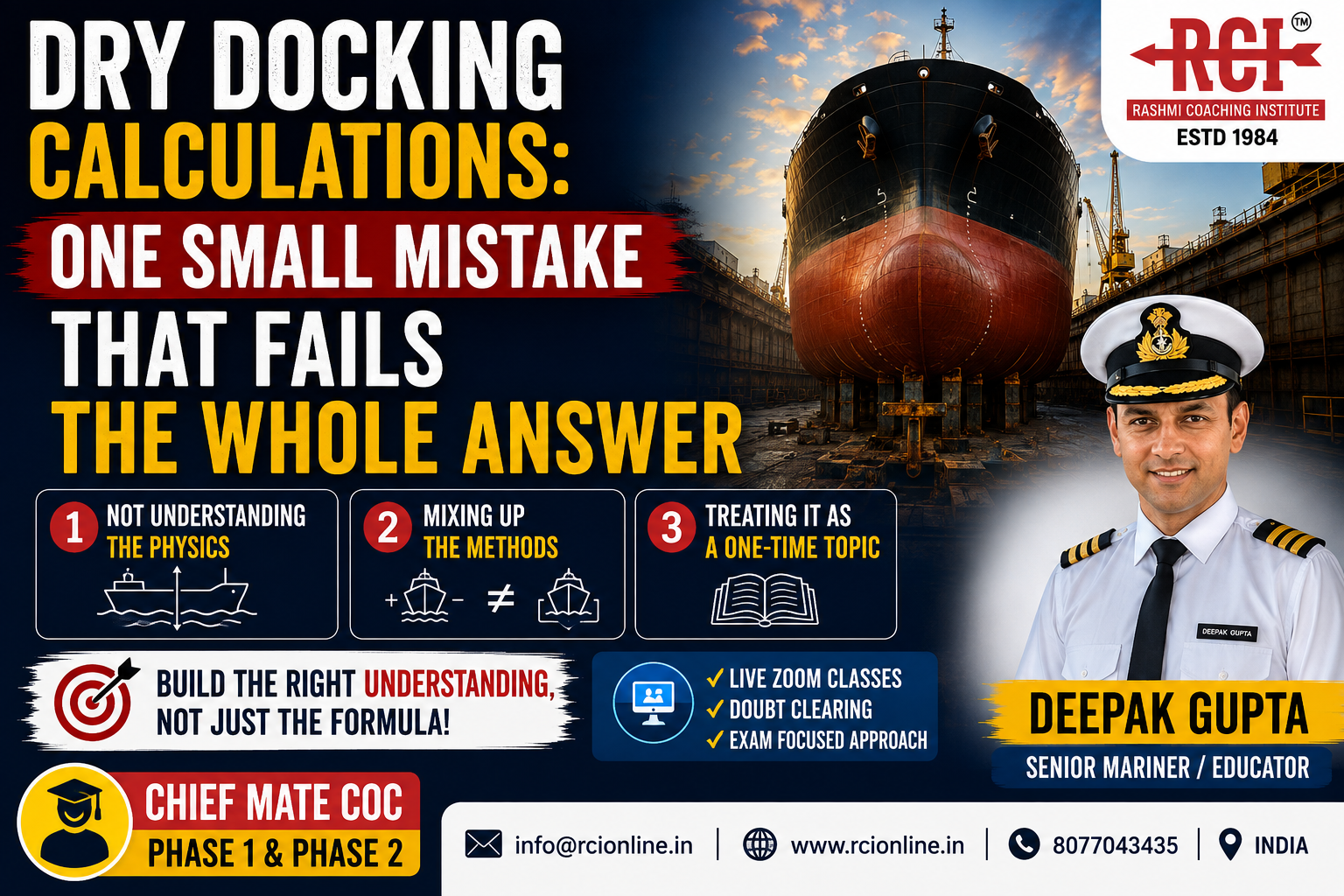
Ask any Chief Mate candidate which stability topic makes them the most nervous, and dry docking and grounding calculations almost always come up. Not because the concept is impossible — but because these two topics have a reputation for punishing even a small error with a completely wrong final answer.
Here's the part most students don't realize: the problem usually isn't the math. It's a handful of conceptual gaps that quietly derail the entire calculation before the numbers even come into play.
A lot of students jump straight into applying a method the moment they see a dry docking or grounding question — without first visualizing what's physically happening to the ship. Is the ship touching the blocks at one point, or is there a force acting somewhere along the length? Is buoyancy being lost, or is it being redistributed?
When the physical picture isn't clear, students end up applying steps mechanically, in the wrong order, or to the wrong reference point. The calculation might look complete, but it's built on a shaky foundation — and one wrong assumption early on cascades into a wrong final answer.
Dry docking and grounding aren't the same scenario, even though students often treat them interchangeably. Grounding can happen at different points along the ship, under different conditions, and each situation calls for a different way of thinking about the problem. The same goes for dry docking — the moment a ship goes from fully afloat to partially supported by the blocks, the entire logic of the calculation shifts.
Students who haven't clearly separated these scenarios in their head tend to force-fit one situation's approach onto another — and that's exactly where marks get lost, even when the arithmetic itself is correct.
Dry docking and grounding don't exist in isolation — they connect directly to broader stability concepts that show up again and again through Phase 1. Students who learn it as a standalone formula to memorize for one exam question often struggle later when the same underlying logic reappears in a different form, dressed up as a different question.
Getting dry docking and grounding right isn't about memorizing more formulas — it's about building the physical picture first, correctly identifying which scenario you're dealing with, and then applying the method with full understanding of why each step exists. That sequence matters, and it's genuinely difficult to build on your own from written notes alone.
What we've consistently seen at RCI Marine since 2019 is that once students go through this in the right order — with live doubt-clearing so misunderstandings get caught immediately instead of compounding — dry docking and grounding stop being the topic they dread and start becoming one of their strongest areas.
Before your exam, ask yourself honestly:
If you hesitated on any of these, that's not a knowledge problem — it's a preparation-sequence problem. And it's very fixable.


RCI Marine (Rashmi Coaching Institute) — Trusted Since 1984. Contact us for live Zoom classes covering Chief Mate COC Phase 1 and Phase 2.
No comments yet — be the first to share your thoughts.