Author - Senior Mariner - Deepak Gupta(Click here to know more)
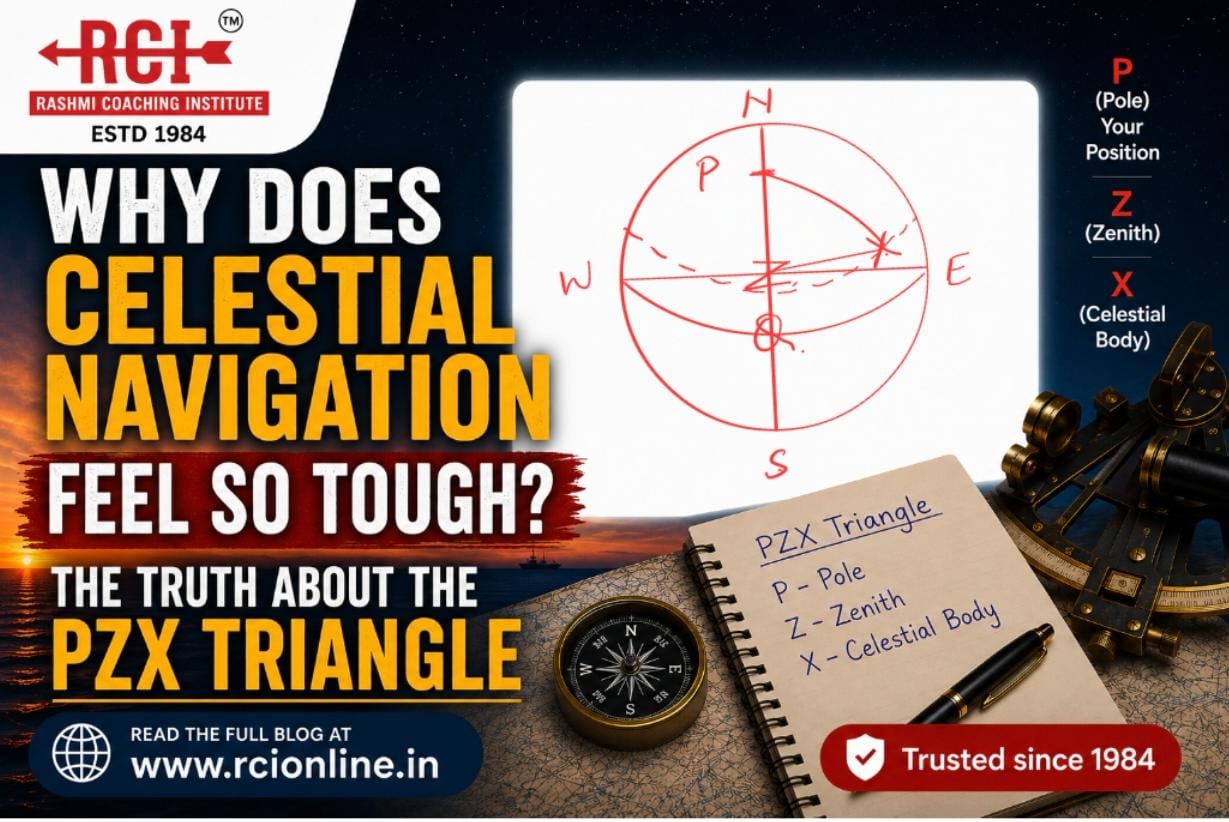
Among all the subjects in Phase 1 of the Chief Mate COC exam, there's one that consistently scares students more than any other — Celestial Navigation. And at the center of that fear sits one thing: the PZX Triangle.
Almost every Second Officer who starts preparing for Chief Mate hears the same line: "Celestial is tough, just mug it up." But here's the truth — celestial navigation isn't actually difficult. The way it's usually taught is what makes it feel that way.
Most students approach the PZX Triangle as a formula to be memorized. They cram it word for word — but the moment the exam throws a slight variation (a star sight instead of a sun sight, a different altitude correction), the whole calculation falls apart.
Why? Because they never actually understood what P, Z, and X represent. These aren't just letters — they represent real 3D geometry describing the relationship between the Earth, the observer, and the celestial body. Until that spatial understanding is clear, the formula remains something you're constantly at risk of forgetting.
Many students study Long by Chronometer, the Intercept method, and Meridian Passage (MERPASS) as if they're three completely separate topics with nothing in common. That's the wrong approach. These are actually applications of the same foundational concept. The day that connection clicks, all three topics suddenly feel far simpler.
Interestingly, a lot of coaching material and online tutorials put heavy focus on topics like running fix and HSA (Horizontal Sextant Angle) — while the real foundation for the Chief Mate exam is Long by Chron, Intercept, and MERPASS. That mismatch is exactly what confuses students — they end up spending time on the wrong things.
This is hard to answer in a single sentence — because truly understanding the PZX Triangle requires a structured, step-by-step process that combines geometry, formula application, and real exam-pattern practice. It's not something that can be fully covered in one blog post.
What we've consistently seen at RCI Marine since 2019 is this: once students learn this concept in the right sequence, with live doubt-clearing along the way, the PZX Triangle stops being "difficult" and starts becoming "mechanical."
If you suspect celestial navigation is your weak spot, ask yourself these questions first:
If the answer to either of these is "no," there's a gap in your celestial prep — and that gap tends to get exposed on exam day, not before.


RCI Marine (Rashmi Coaching Institute) — Trusted Since 1984. Contact us for live Zoom classes covering Chief Mate COC Phase 1 and Phase 2.

Very well explained. Good job